Friday, 2 September 2011

Small Red-eyed Damselflies in Gloucestershire


September 1, 2011:
A large pool near Tewkesbury known for its rich dragonfly fauna also has the fairly scarce Small Red Damselfly (Erythromma viridulum). With hot sunny weather forecast for the day, a visit was made especially to see this species.


Small Red-eyes are relatively tiny damselflies but are superficially similar to the closely-related and much more widespread Red-eyed Damselfly (E. najas). They are however smaller and more delicate and have a narrower, waisted abdomen which is noticeably swollen near the apex. Perhaps the best identification character though is the colour of the second and eighth segments which is mostly blue (but largely black in the larger species).


[Small Red-eyed Damselfly (E. viridulum) the with blue coloration clearly visible on segments 2 and 8]


[An enlarged view showing segments 2 and 8 to be mainly blue]


[For comparison, a Red-eyed Damselfly (E. najas) showing segments 2 and 8 to be mainly black]

The males spent all the time out on the open water where they perched on floating vegetation and lily-pads and were not easy to view closely or to photograph. They need warm sunny weather to be active and today this ceased immediately the sun went in. Small Red-eyes are quickly spreading northwards and have already reached as far as the Midlands.


Some tandem pairs were also seen ovipositing on the floating sphagnum, as below.


[The larger Red-eyed Damselfly (E. najas) was also present with its comparatively broader, non-waisted abdomen]

Also seen at the pool were Common and Ruddy Darters, Southern, Brown, and Migrant Hawkers, one Red-eyed Damselfly, many Common Blue and Blue-tailed Damselflies and a few Banded Demoiselles. A Kingfisher also put in appearances on several occasions.


[Ruddy Darter]

Tuesday, 23 August 2011

Intense Dragonfly activity at Foulshaw


August 22, 2011:
Very warm calm weather led to a high degree of dragonfly activity at a small pool here today. A huge number of Black Darters could be seen engaged in a range of activities. At one point four tandem pairs were ovipositing in a damp patch no larger that a dinner plate. Other mating pairs were perched in the vegetation and mature males posed at vantage points by the water margin. However the immatures and females kept some distance away from the water's edge.


Mating pair of Black Darters]


[Black Darter males, above]


[Black Darter, female]

Many Emeralds were also present, most of them males.


[Emerald Damselfly, male, both above]

At least one Brown Hawker was flying as well as a Southern Hawker which lived up to its reputation of buzzing human intruders. An Emperor put in a brief appearance and Commom Blues accounted for the other damselfly species present.lak

Saturday, 20 August 2011

Badgers at a sett in a Lancashire valley


August 17, 2011;
One of the rather rare beautiful evenings of the summer provided an opportunity to watch badgers under good conditions. The sett, in heavily shaded woodland, had many entrances, some of which showed evidence of recent excavation.


In the deep shade as the light faded the first badger emerged at about 19.45 hours. This was soon followed by another and both began to search the bare earth for worms and grubs. As darkness fell further, more badgers appeared until at one time six individuals could be seen simultaneously. There was a range of sizes from adults to well-grown cubs.


Conditions for photography were very challenging and camera settings needed to be at the extreme. Flash was used occasionally and didn't appear to concern the badgers which carried on searching for food normally although they were quickly alerted by the slightest noise. However, the best photos were achieved in normal light despite being very poor. After a two hour watch the badgers were left to themselves.


Wednesday, 17 August 2011

Chalk grassland butterflies at Aston Rowant


[Chalk-hill Blue male]

August 15, 2011:
It being almost one year to the day, another visit to the Chilterns to the butterfly-rich grassland at Aston Rowant was now due. Conditions were reasonable but still less than ideal with a very strong breeze and intermittent sunshine. Flying here were many Chalk-hill Blues which especially favoured patches of Marjoram for nectaring. At the same place there were also several Brown Argus similarly attracted to the flowers.


[Chalk-hill Blue male, both above]


[Brown Argus, both above]


[Chalk-hill Blue male and Brown Argus female]

Above the short turf, very fast-flying Silver-spotted Skippers would appear during bursts of sunshine but quickly settled to perch on the bare gravelly rabbit scrapes when the sun disappered. This enabled them to benefit from the heat radiated by the stony surface.


[Silver-spotted Skipper male, both above]

On one occasion a brief glipse was gained of a very bright light blue butterfly, very likely to be an Adonis Blue, but it disappeared before it could definitely be confirmed. Adonis's are known to occur at this site although in very low numbers. There were also many Meadow Browns and Small Heaths as well as a few Small Coppers.

Thursday, 11 August 2011

Butterflies in the Peloponnese, Greece (2)

June 18-21, 2011:
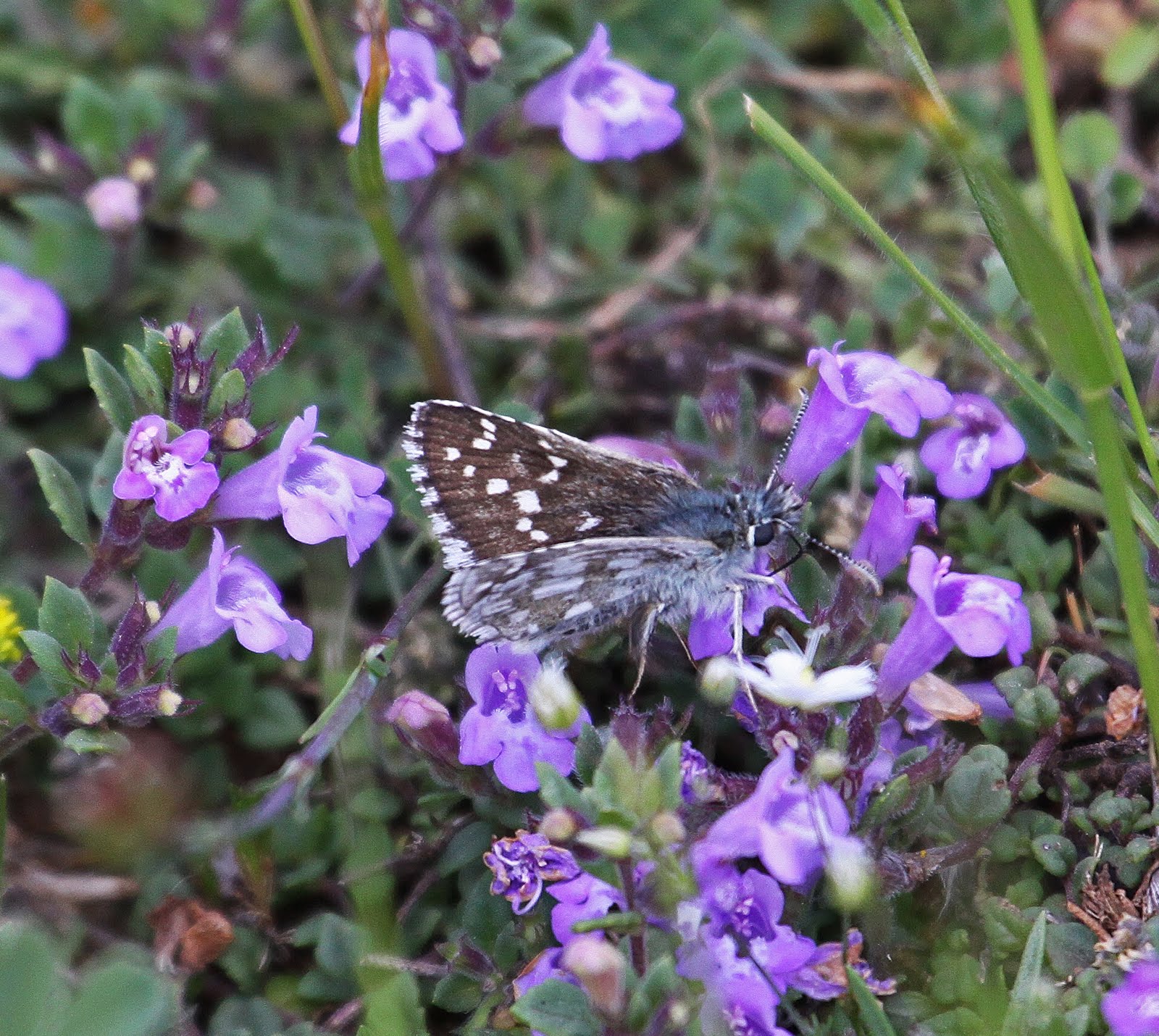
Skipper and 'Blue' butterflies in southern Europe are quite difficult to identify with accuracy. However, some of those seen recently in the northern Peloponnese are shown here. This is the second part of a posting initially made several weeks ago.


Most of these butterflies were seen on the middle slopes of Chelmos (at about 1500 m altitude) where they were visiting trackside flowers or higher up on the flowery meadows of the Xerocampos. Skippers seen on the mountain included Oberthur's Grizzled (Pyrgus armoricanus), Orbed Red Underwing [=Hungarian Skipper] (Spialia orbifer), Olive (Pyrgus serratulae) and Dingy (Erynnis tages). At lower level there were Small (Thymelicus sylvestris), and Marbled Skippers (Carcharodus lavatherae), the latter seen taking salts from moist red mud.


[Oberthur's Grizzled Skipper (and top photo also)]


[Orbed Red Underwing Skipper]


[Olive Skipper]


[Marbled Skipper, taking salts on terra rossa mud]

Also on Chelmos were Adonis Blues (Lysandra bellargus)and Pontic Blues (Neolysandra coelestina) (the latter becoming rather worn since it was late in their season). Unfortunately, the endemic Chelmos Blue was not identified with certainty. At lower levels, two other blues were on the red mud along with the Marbled Skippers. These have been tentatively identified as Osiris Blues (Cupido osiris) and Zephyr Blues (Plebejus pylaon).


[Adonis Blue]


[Pontic Blue, a rather worn specimen]


[Osiris Blue, tentative i.d.]


[Zephyr Blue, tentative i.d.]

Alternative suggestions are welcomed for the last two (please click on 'Comments' below).

Thursday, 4 August 2011

Ruddy Darter (Sympetrum sanguineum) at Silverdale, Lancashire, and butterflies at Latterbarrow, Cumbria


August 3, 2011:
A small sheltered pool near Silverdale, a known site for Ruddy Darters, was visited for the second time in eight days. Unlike last week when none was seen, this time a single brightly coloured male patrolled the pool margin.


[Ruddy Darter, showing the all-black legs, waisted abdomen and club-shaped tail]

Several Emerald Damselflies perched on the marginal vegetation and two Southern Hawkers flew high amongst the surrounding trees.


[Emerald Damselfly, female. The two diagnostic sub-triangular marks on segment 2 can be seen]

Earlier in the day a visit in ideal conditions to limestone grassland at Latterbarrow was rewarded with a large number of Peacocks nectaring on marjoram along with pristine Red Admirals. Also there was a single Brimstone but it was too late in the season for the Northern Brown Argus which may sometimes be seen here. Of particular interest also, was a nice fresh example of the Small Copper aberration (ab. caeruleopunctata (Tutt)).


[Peacock]


[Red Admiral]


[Brimstone]


[Small Copper ab. caeruleopunctata (Tutt)]