Thursday, 28 April 2011

BUTTERFLY: Paphos Blue (Glaucopsyche paphos) in Cyprus

April 7, 2011:
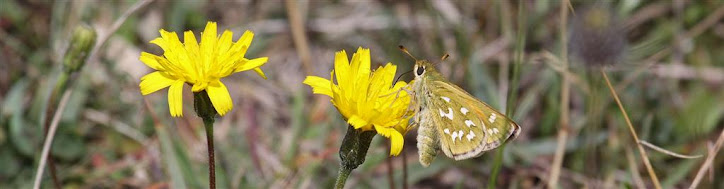
Near Kidasi in the Dhiarizos valley fifteen kilometres to the east of Paphos, this endemic Spring butterfly was flying in good numbers although disinclined to settle. When it did so briefly to take nectar from a bright yellow crucifer there was just chance for a photograph.


In Cyprus to where it is endemic it is common although found mostly in the west and south of the island on the warm chalky garrigue. Its larval foodplant comprises various species of Genista (brooms) which are usually thorny bushes. The butterfly photographed here is a male and exhibits a bright blue upperside with a black band around the margin and the characteristic greyish underside with large black spots ringed in white in the post-discal area of the forewing.

Thursday, 14 April 2011

ORCHIDS: Cyprus March-April, 2011

March 29-April 7, 2011:
The chalk garrigue lying within a triangle between the villages of Kidasi, Omodhos and Monagri in south-west Cyprus is rich in orchids. Many can be found near the roadside and often there are several different species growing in close proximity to each other. However, within the same general area and habitat there will be many other places where there are none at all, indicating that the conditions there are not exactly correct for these very demanding plants.

At the time of the visit many species were in flower, especially those of Ophrys (‘bee orchids’) with their strikingly spectacular flowers. Between Kidasi and Omodhos there was Ophrys israelatica, Ophrys asiatica, Orchis quadripunctata in two colour forms, Orchis italica and Barlia robertiana.


[Ophrys israelitica]


[Ophry asiatica]


[Orchis quadripunctata]


[Orchis quadripunctata, white form]


[Orchis italica]


[Barlia robertiana]

A chalk roadside near Monagri had Ophrys flavomarginata, O. umbilicata, O. iricolor and, quite surprisingly a few plants of the rare endemic Ophrys kotschyi (perhaps a new locality?).


[Ophrys flavomarginata, both above]


[Ophrys umbilicata]


[Ophrys iricolor]


[The rare endemic Ophrys kotschyi, both above]

A small gorge just south of Kidasi had Serapias bergonii, Ophrys lutea subsp. galilea (=O. sicula) and more Ophrys flavomarginata and Orchis italica.


[Serapias bergonii]


[Ophrys lutea subsp. galilea]

At this site there was also Bellevalia trifoliata (a monocotyledon but not actually an orchid). At Monagri there was another interesting monocotyledon: Gagea fibrosa.


[Bellevalia trifoliata]


[Gagea fibrosa]

Thanks to Yiannis for help with some of the ids.

Wednesday, 9 March 2011

LICHEN: Peltigera praetextata in Cumbria

March 8, 2011:
Deciduous woodlands in Cumbria are the home to several species of lichen which are scarce elsewhere in England. Whilst searching for some of these yesterday, another more widespread lichen was seen and photographed. This was Peltigera praetextata Floerke ex Sommerf. which was growing on moss-covered boulders in woodland on the west side of Ullswater.


[Colour when dry; photo width = approx 10cm]

It is a relatively large 'leafy' lichen which anchors itself to the substrate by spike-like growths (rhizines) on its underside. The upper surface is brown to pale grey when dry but becomes dark grey or almost black when wet. The surface is bullate (i.e. it has raised vein) whilst the margins and surface cracks of older specimens can bear isidia (outgrowths containing its photosynthetic partner).


[Colour when wet. The isidia can be seen and also the bullate surface (in the lower part)]

This is the only relatively common British species of Peltigera which bears surface isidia. It is widespread and locally common on mossy boulders, tree-bases and on damp, heathy slopes.


[Showing the spike-like rhizines on the underside]

Friday, 11 February 2011

MAMMAL: Otters in Cumbria

February 10, 2011:
There have been several recent reports of Otters being seen at a locality in Cumbria so today's unexpected glorious weather gave an opportunity to go to look for them.


A short wait by the lake-side was rewarded by the first sighting as what appeared to be a young one surfaced and rolled about in the water for a few seconds. Soon afterwards a group of three appeared, their size suggesting them to be an adult and two juveniles. These two engaged in a playful squabble before the parent guided them away out of view. There are frequent sightings of Otters in the north-west nowadays suggesting that they are undergoing a significant revival from their former scarcity when they suffered from the poisonous effects of chlorinated pesticides.


Sunday, 19 December 2010

PLANT: Salvia veneris (Hedge) a Cyprus narrow endemic


Date retrospective: April 2001:
Salvia veneris is a beautifully-flowered extremely narrow endemic restricted to an area of only a few square kilometres of ecologically-interesting terrain around Kythrea (Degirmenlìk) in northern Cyprus. The plant has rounded, flattened, thickly felted grey-green leaves, nearly all of them basal. The flowers have a pale sky-blue hood and a cream-yellow lower lip finely flecked with darker markings although I've also found a few plants with pure white flowers.


[White-flowered form]

The substrate where it grows comprises barren eroded sandstones and marls and plants are usually found on the slopes of small hummocks amongst minimal competition. Such open dry earth is very loose and friable and although quite deep-rooted, the plants (and the habitat) can be easily damaged by trampling. They occur in discrete local populations, often comprising only 10 to 30 individuals and can be surprisingly difficult to detect against the greyish soil.


[Several plants can be seen as grey patches scattered on the friable substrate]

Salvia veneris occurs in loose association with several other interesting plants which include the recently discovered Wiedemannia orientalis Fisch. & Mey. and the endemic Hedysarum cyprium Boiss.


[Wiedemannia orientalis]


[Hedysarum cyprium]

Salvia veneris was first discovered by the party of botanists led by the Englishman John Sibthorp during a tour of the eastern Mediterranean in 1787; a specimen which they collected is preserved in the Oxford University herbarium. In addition, a beautiful and accurate painting was made by Ferdinand Bauer, the renowned Austrian natural history artist, who accompanied Sibthorp's party and an engraving of this is reproduced in ‘Flora Graeca' published by James Smith in 1806. Unfortunately no locality details were given on the preserved specimen and so the precise place where it was first collected is uncertain but may have been a little to the west of the limited area from which it is now known.

For a detailed account of this plant and its close relatives, see the Karaca Arboretum Magazine Vol 7 part 1 (Foley 2003).

Monday, 6 December 2010

PLANT: Arenaria norvegica subsp anglica (English Sandwort) in the British Isles.


Arenaria norvegica subsp. anglica, Ingleborough, North Yorkshire

Date: retrospective to the mid 1990s
This very scarce small white-flowered plant is a member of the Caryophyllaceae (Pink family). Arenaria norvegica occurs in Britain as two distinct sub-species (subsp. anglica and subsp. norvegica). The former, subsp. anglica, is a British endemic (i.e. not known elsewhere in the world) and is restricted to just a small area of the Yorkshire Dales whereas subsp. norvegica, although still scarce, is rather more widespread and is found in the Assynt area of Sutherland, Shetland, Argyll, the Isle of Rhum and western Ireland.
Subspecies anglica is biennial with narrow elliptic-ovate leaves, flowers to c.20mm in diameter and with three styles; subsp norvegica is perennial, has obovate leaves and smaller flowers bearing 3-5 styles.


Subp. anglica, Crummack, Ingleborough

Most populations of subsp. anglica are to be found on the limestone pavement area on the eastern flank of Ingleborough although it can easily be overloooked. It prefers very thin soils over well-drained limestone and grows in cracks and small depressions in the rock where competition from other plants is minimal. It has also been found in damp flushes and occasionally has colonised track-sides where limestone gravel has been laid as a base. In the early 1990s I took part in a survey of the plant on Ingleborough where eventually 27 separate populations were found in this very limited area. Population sizes can fluctuate dramatically depending on climatic conditions at the time of flowering (May onwards).


Subsp. norvegica, River Loanan shingle, Inchnadamph, Sutherland

Subsp. norvegica is also restricted to limestone substrates. In Scotland it mostly grows on fine scree and on riverside gravels (as above). In Ireland it was recorded on a single occasion in 1961 on extensive pavement in the Burren but couldn’t be re-found in subsequent years and was thought extinct until rediscovered in 2008. It also occurs in Scandinavia and Iceland.

Monday, 22 November 2010

HOVERFLIES: Some common Lancashire hoverflies

August 25-27, 2010:
A few photographs of some local hoverflies are below. Identification to species level (and even to genus) can often be difficult. Some of those shown are only named tentatively and therefore open to correction.


Heliophilus pendulas, Hawes Water, 25.8.2010


Heliophilus pendulas, Brockholes Wetland, 27.8.2010


Episyrphus balteatus, Mere Sands, 26.8.2010


Episyrphus balteatus, Hawes Water, 25.8.2010


Eristalis pertenax, Hawes Water, 25.8.2010


Syrphus vitripennis, Mere Sands, 26.8.2010


Syrphus vitripennis (left) & Episyrphus balteatus, Mere Sands, 26.8.2010


Query Epistrophe grossulariae, Hawes Water, 25.8.2010


Query Melanastoma scalare, Brockholes Wetland, 27.8.2010


Query Eupeodes luniger, Brockholes Wetland, 27.8.2010

Tuesday, 2 November 2010

FUNGUS: Some gasteroid fungi in north-west England

September 28-October 4, 2010:
'Gasteroid' is a loose term used to describe fungi in which the spores are developed within the closed fruitbodies. The result is that the spores are not forcibly dicharged but are released passively often through a central hole (ostiole) by the aid of external agents such as wind or falling rain drops. The group includes those fungi well-known as puffballs, earthstars, etc. Dunes and woodlands are typical habitats with those at Ainsdale NNR near Southport being especially rich. A few seen and photographed recently are shown here.


[Dunes at Ainsdale]

Lycoperdon perlatum, Common Puffball, (below) occurs either singly or in small clusters and has its outer surface delicately covered with fine spines or 'pearls'. It is widespread in Britain and very common at Ainsdale where photographed here.


[Fruitbodies from which the spores have been expelled]


[Above, probably the closely-related Lycoperdon nigrescens, Ainsdale dunes]

Lycoperdon excipuliformis, Pestle-shaped Puffball (below) also occurs at Ainsdale but less frequently. It mainly differs from the above in its shape as suggested by its common name. It is more elongated and taller than L. perlatum.


[Lycoperdon excipuliformis at Ainsdale]

Lycoperdon pyriforme, Stump Puffball, is common throughout the country and grows in woodland on strongly-decaying wood. Photographed below at Eaves Wood, Lancashire in 2008.


[Lycoperdon pyriforme]

Scleroderma citrinum, Common Earthball, (below) is tinged yellowish and has coarse scales or warts on its outer surface. It favours acidic woodlands and heaths and is often associated with birch, beech or oak. Here it was growing amongst scattered birch on the heath at Foulshaw Moss, Cumbria.


[Scleroderma citrinum]

Geastrum triplex, Collared Earthstar, is probably the commonest species within the genus. The expanded fruit body splits into several arched rays to reveal the onion-shaped central body. Often found on dunes or in calcareous woodland as here at Silverdale.


[Geastrum triplex]