Showing posts with label Plant. Show all posts

Monday, 6 December 2010

PLANT: Arenaria norvegica subsp anglica (English Sandwort) in the British Isles.


Arenaria norvegica subsp. anglica, Ingleborough, North Yorkshire

Date: retrospective to the mid 1990s
This very scarce small white-flowered plant is a member of the Caryophyllaceae (Pink family). Arenaria norvegica occurs in Britain as two distinct sub-species (subsp. anglica and subsp. norvegica). The former, subsp. anglica, is a British endemic (i.e. not known elsewhere in the world) and is restricted to just a small area of the Yorkshire Dales whereas subsp. norvegica, although still scarce, is rather more widespread and is found in the Assynt area of Sutherland, Shetland, Argyll, the Isle of Rhum and western Ireland.
Subspecies anglica is biennial with narrow elliptic-ovate leaves, flowers to c.20mm in diameter and with three styles; subsp norvegica is perennial, has obovate leaves and smaller flowers bearing 3-5 styles.


Subp. anglica, Crummack, Ingleborough

Most populations of subsp. anglica are to be found on the limestone pavement area on the eastern flank of Ingleborough although it can easily be overloooked. It prefers very thin soils over well-drained limestone and grows in cracks and small depressions in the rock where competition from other plants is minimal. It has also been found in damp flushes and occasionally has colonised track-sides where limestone gravel has been laid as a base. In the early 1990s I took part in a survey of the plant on Ingleborough where eventually 27 separate populations were found in this very limited area. Population sizes can fluctuate dramatically depending on climatic conditions at the time of flowering (May onwards).


Subsp. norvegica, River Loanan shingle, Inchnadamph, Sutherland

Subsp. norvegica is also restricted to limestone substrates. In Scotland it mostly grows on fine scree and on riverside gravels (as above). In Ireland it was recorded on a single occasion in 1961 on extensive pavement in the Burren but couldn’t be re-found in subsequent years and was thought extinct until rediscovered in 2008. It also occurs in Scandinavia and Iceland.

Sunday, 8 August 2010

PLANT: Bladderwort at Leighton Moss, Lancashire


August 7, 2010:
Common Bladderwort (Utricularia vulgaris s.l.) is flowering now in some of the fen pools at Leighton Moss Reserve. Bladderworts are very sophisticated aquatic carnivorous plants. They comprise an underwater structure of roots and leaves in the form of long stolons to which small bladders are attached by thin stalks whilst the bright yellow flowers project above the water surface on leafless stems. When flowering en masse as at present, they make a spectacular sight and can be seen from one or two places along the causeway there.


The bladders themselves are active traps in which small organisms such as larvae and water fleas are caught and later ingested by the plant. Each bladder comprises a vacuum possessing a negative pressure so that when small amounts of animal matter brush against its sensitive trigger hairs a trapdoor in the bladder opens and the prey, together with its enveloping water, is sucked inside. The trap then closes within a few milliseconds and dissolution of the prey by digestive secretions begins. A similar species, U. minor, is found in more acidic waters in Cumbria and elsewhere. Bladderworts are members of the Lentibulariaceae family to which the terrestrial Butterworts also belong.

Thursday, 22 April 2010

PLANT: Cotoneaster induratus, new to Lancashire as a naturally-sown plant

October 17, 2009:
Although in this country Cotoneasters are usually grown as garden plants or for amenity decoration they also often spread into the natural environment when bird sown. This is a result of birds eating the ripe berries, the seed of which passes through them undigested and is later spread into a new habitat via their droppings.


A single magnificent shrub of Cotoneaster induratus was discovered and photographed (above and below) in a semi-natural habitat in a disused limestone quarry near Carnforth. It was laden with bright red berries and was a most attractive sight. Initially there was uncertainty as to its identity until it was confirmed as this species by Mrs Jeanette Fryer. Unfortunately, the quarry is now scheduled for housing development and even though this is the only naturally-grown representative of the species in the county, it is quite likely to be lost soon.


In this species the orbicular bright red fruits are slightly hairy whilst the new leaves and stems are much more so.


Other species of Cotoneaster present at the locality include C. dielsianus, C. horizontalis, C, rehderi and C. simonsii.

Monday, 29 March 2010

PLANT: A rare endemic wormwood: Artemisia granatensis in Spain

July 1, 1995:
Nowadays, this extremely rare endemic is only occasionally found on the upper peaks of the Sierra Nevada, southern Spain, at altitudes of 3200 metres upwards. Its typical habitat is the stony or gravelly schistose slopes and consolidated scree found there. Commonly known as "manzanilla de la sierra", at one time it was frequent down to 2500 metres but has since been grossly over-collected on a commercial basis. This was by the 'manzanilleros' for its value as a medicinal herb and as an ingredient for the sherry-like aperitif, manzanilla, but the plant can still occasionally be found. In the past, miraculous cures were attributed to it although its main medicinal property was its use in alleviating digestive problems. As it became over-collected and scarce the price rose so that it was often unscrupuously adulterated with wild thyme and other aromatic plants collected from the upper regions of the mountain.


A. granatensis is a small plant with crowded, deeply divided, basal leaves and more entire upper leaves. The inflorescence, which can be up to 10cm tall, bears up to three capitula in a rather crowded, short raceme. The whole plant is covered with a dense, setaceous indumentum which gives it a distinctive silvery-grey, silky appearance. When bruised, the leaves give off a strong but very pleasant aromatic odour.


Artemisia granatensis can still be found on the highest peaks of the Sierra Nevada, such as Mulhacen, Puntal de Siete Lagunas, La Alcazaba and, where photographed in early July, on the upper slopes of the Veleta at 3250 metres. It has also been recorded in the eastern foothills of the Sierra Nevada on Buitre and Borrachera in Almeria province.


Above, the barren upper slopes (left centre) below the Veleta summit where A. granatensis was seen and photgraphed.

PLANT: An endemic Butterwort (Pinguicula nevadensis) in the Spanish Sierra Nevada

July 8, 1998:
Endemic to the upper regions of Sierra Nevada and the Sierra de Alfacar in southern Spain, Pinguicula nevadensis occurs in small groups on gently sloping damp turf and flushes from 2400 metres upwards with a limit at about the 3000 metre contour. It is often found near the margins of some of the higher ex-glacial tarns as well as in the ‘borreguiles’. These are fragile, boggy seepages or rivulets and show up as bright green patches against the drab stony terrain; they tend to develop as the ground thaws out at the beginning of summer.


P. nevadensis is a small plant with a few waxy-green, glandular-surfaced leaves. Like other European members of the genus it is carnivorous and gains nutrients by absorption of organic material from any small flies and insects trapped on its sticky leaf surfaces. There are usually 1-3 flowering stems, the flowers borne singly on erect pedicels. Flowering is from early July to August depending on the season. It was first discovered by Edmund Boissier when travelling to the upper regions of the Sierra Nevada in 1837.


Below: The Laguna d’Aguas Verdes, Sierra Nevada, a high alpine tarn at c.3000 metres whose margins provide a habitat for the plant.

PLANT: The orchid hybrid between ‘man’ and ‘monkey’ (Orchis anthropophora × Orchis simia) in Kent

May 20, 1989:
This most attractive but extremely rare hybrid orchid, a cross between the Man and the Monkey orchid, was recorded in Kent at a locality near Ospringe on several occasions in the late 1980s; at that time it was known as ‘Orchiaceras’ × bergonii. It occurred in species-rich chalk grassland together with both parents, although O. simia (Monkey orchid) itself was usually a very scarce plant everywhere. There was a suspicion at the time that the parents might have been given a little help via hand-pollination. This hybrid is also known to occur elsewhere in Europe.


When seen and photographed (above) in mid-May 1989, there were two plants of the hybrid along with more than 50 plants of Orchis simia (below) and one of O. anthropophora.

Sunday, 28 March 2010

PLANT: A rare hybrid sedge in north Lancashire

July 3, 2008:
In June, a sharp-eyed botanist found a sedge (Carex sp.) of unusual appearance which he thought might be the hybrid Carex pseudocyperus × C. rostrata (C. ×justi-schmidtii nom. nud.) at a wetland site in north Lancashire. Having just completed an account of British hybrid Carex for ‘Sedges of the British Isles’, Mike Porter and I decided to take a look.


There were two plants growing close together in fen vegetation on the drier, inner side of a dense belt of Phragmites surrounding a small sheet of water. Carex pseudocyperus, a potential parent and a fairly distinctive species, grew close by but C. rostrata, locally common in the area, wasn’t seen.

The two plants, which we now confirmed as the hybrid C. ×justi-schmidtii, were superficially closest to C. pseudocyperus but could be distinguished from both parents in having stomata (small white pores) present on both the upper and lower surfaces of the leaves. They also possessed longer, narrower, usually less dense and somewhat more erect, female spikes compared to C. pseudocyperus.

This hybrid is very rare in the British Isles and had been previously recorded only from one site in Norfolk and from two in Ireland.


The hybrid (both photos above)


Carex pseudocyperus (both photos above)

Saturday, 27 March 2010

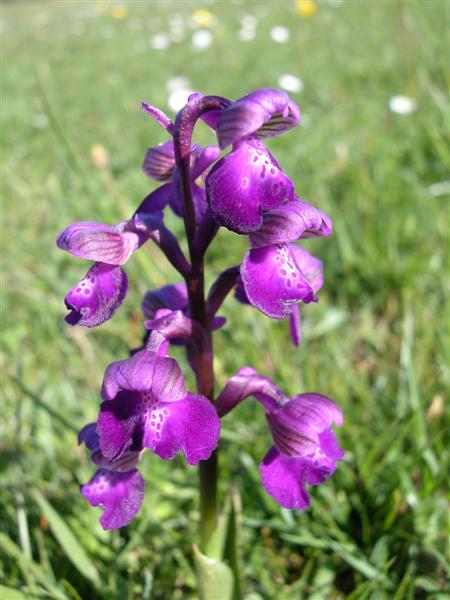
PLANT: Anacamptis morio (Green-winged Orchid): variable flower colour at a Lancashire site

May 1, 2007:
Anacamptis (or Orchis if preferred) morio is commonly known as the Green-winged Orchid. It is a plant of unimproved, species-rich, grazed calcareous grassland and flowers in early May. It is a scarce plant in north-west England much of its habitat having been gradually destroyed through modern agricultural practices. However, some sites are specially reserved for it and for other similarly-scarce plants. This site is one of them and is of interest in that the orchid is often present here in a range of colour forms. In a good year, several hundred plants may be found in flower.


Thursday, 25 March 2010

PLANT: Helichrysum taenari, a very rare narrow endemic from southern Greece

May 15, 2002:
In 1944, during the Second World War when the German army occupied Greece, one of its personnel, the botanist Werner Rothmaler, explored the extreme southern tip of the Mani peninsula searching for plants. This southern tip is known as Cape Taenari and is the central of the three south-pointing peninsulas which gives the map of southern Greece its characteristic outline.

In a remote ravine near the deserted village of Korogonianika, Rothmaler discovered a white-flowered member of the daisy family (Asteraceae) growing in the crevices of a steep limestone cliff and which he identified as being a new species of Helichrysum (a type of Everlasting Flower). This was a chasmophyte, a plant restricted to a cliff-face habitat, and he named it Helichrysum taenari after the area. The type specimen which Rothmaler collected was lost when the Berlin herbarium was bomb-damaged shortly afterwards and he probably wrote his original description of the plant from memory. It was subsequently thought to be extinct until re-found by Arne Strid’s party in 1984 at what appeared to be Rothmaler's original locality. Unfortunately, shortly afterwards in the 1990s, the ravine was engulfed by fire and it was feared that the plant was lost.


In 2002 we paid a visit to the area to try re-find the Helichrysum. The vegetation in the ravine had quickly recovered and was now a dense mass of spiny shrubs which reached head height and above. This dense growth in the ravine bed was penetrated with great difficulty (and painfully) but eventually a small clump of what appeared to be Rothmaler’s white-flowered plant was spotted through binoculars, high on the cliff-face.


A closer approach was out of the question but following a hazardous extrication from the ravine, access seemed feasible from above and this was eventually achieved by a long circuitous route.


From the top of the cliff, several flowering plants could be seen at various points on the face below and after a careful descent some were photographed. Later, a single seedling was found growing in a crevice of a disused vine terrace nearby.


It was very encouraging to establish that despite the fire this extremely rare plant still survived at its original locality. Although a second site for it had been found by a separate group of botanists at Vathia, another deserted village nearby, these were the only two known localities. In the 17th and 18th centuries the whole Mani peninsula was a lawless no-go area. Today it is peaceful but largely uninhabited so that the plant should have every chance of survival.


The distinctive square-towered houses of the southern Mani at the deserted village of Vathia. This is within the limited area where Helichrysum taenari occurs.

Wednesday, 24 March 2010

PLANT: Two similar-looking Fumitories (Fumaria capreolata and F. purpurea)

July 1 & 4, 2009:
Fumaria capreolata and F. purpurea appear very similar and are easily confused. They have almost the same habit and have flowers of similar shape and colour. They are the only two British species in which the flowers become sharply inclined downwards as they mature. F. purpurea is known from only limited areas of the country and is classified as a Red Data Book plant so, being rare, its correct identification is important. F. capreolata is more widespread and is often found in areas close to the coast. Both are most attractive plants despite occurring as weeds in ruderal or arable habitats.


Fumaria capreolata (above)


Fumaria purpurea (above)

The main distinguishing characters are relatively slight. Although the flowers of both species turn pink on maturity, those of F. capreolata are almost pure white initially whereas those of F. purpurea bear a distinct pinkish flush. When the corollas are viewed laterally (see below) the upper central keel is often still visible in F. capreolata but not so in F. purpurea. Also, the inflorescence of F. capreolata is usually more sparsely-flowered. As with many difficult species they can sometimes best be separated by their almost undefinable ‘jizz’.


Flowers of F. capreolata (top) and F. purpurea (bottom)

The plants were examined and photographed near Lancaster (F. purpurea) and Scarborough (F. capreolata) in 2009.

PLANT: A scarce marsh orchid (Dactylorhiza traunsteinerioides) new to Cumbria

June 14, 2009:
A most experienced botanist and friend, Jeremy Roberts, contacted me to say that he had found some interesting marsh orchids which he thought to be a first record for that particular species in Cumbria, and suggested that we should go and take a look at them together. There were eight plants in flower close to a stream on small grazed ledges on a fairly steep slope in upland limestone pasture. The plants were grouped 4, 3 and 1 and the groups were within 2 to 3 metres of each other and all were at peak-flowering. Close associates included Schoenus nigricans, Carex ornithopoda, C. capillaris, Primula farinosa, etc. Whilst at the date of the visit the ground was dry, run-off from the slopes above, no doubt provided fairly continuous flushing of the habitat.

All eight plants were small, rather delicate and usually possessed two narrow, recurved (often folded) sheathing leaves with a small cauline leaf above; most leaves were unspotted, some just slightly so. In all cases the inflorescences were few-flowered, lax, and one-sided, the individual flowers were reddish-purple, relatively large and with broad labella. These latter were trilobed to differing degrees, usually with the central lobe the longest and were rather obscurely marked with dashes and dots, etc. The bracts were strongly anthocyanin-stained as was the upper stem below the inflorescence. All the above characters relate to Dactylorhiza traunsteinerioides and their identification as such was confirmed.


Tuesday, 23 March 2010

PLANT: Eight species of Draba from Spitsbergen (Svalbard)

July, 2007 & 2008:
Twelve species of Draba (a genus within the cabbage family, Brassicaceae) form an interesting and important component of the high arctic flora of Spitsbergen. It is a taxonomically-difficult genus in which apparently minor characters such as the type and distribution of hairs and the shape of the fruit pods (siliculae) can be critical for their identification. Flower colour are white, cream or yellow. Plants on which there are simultaneously flowers and fruits are the easiest to identify. On Spitsbergen, the various species occupy habitats subject to harsh climatic conditions. These include ‘polygons’ or patterned ground produced by repeated freeze-thaw cycles of the tundra as well as open habitats such as dry screes, gravels and exposed slopes. Eight of the twelve species known from Spitsbergen (some of them very scarce) were seen during visits in 2007 and 2008 and are shown here. All are small, cushion-like rosette plants usually no more than 5 cm high, often less.


Draba arctica J. Vahl (above)
Leaves and stem densely covered with stellate hairs, petals white-cream, about twice as long as the sepals. Gravelly slopes, moraines, rocky hillocks


Draba corymbosa R. Br. (above)
Leaves entire, distinctly pubescent comprising a mixture of hair types, flowers bright yellow, short and broad, siliculae pubescent. Dry gravels with a seasonal thin cover of snow


Draba glabella Pursh. (above)
Leaves lightly toothed with stellate hairs, stems with patent, unbranched hairs, petals white-pale yellow. Dry places, screes.


Draba lactea Adams (above)
Small plants, leaves entire with a few unbranched and branched hairs on the margins, stems glabrous, petals large, white. Moist places, often amongst bryophytes


Draba micropetala Hook. (above)
Leaves entire with dense stellate hairs and rounded apices, stems pubescent, flowers small with narrow yellow petals. Open places on gravel and patterned ground.


Draba norvegica/arctogena Gunn. (above)
Leaves oblong, slightly dentate, bearing a mixture of hair types, flowers white, inflorescence spreading, siliculae oblong, acute. Dry gravels and stony areas. D. norvegica is very variable and forms part of a complex of closely-related species which can be very difficult to identify (as in this case)


Draba oxycarpa Sommerf. (above)
Leaves almost glabrous stem pubescent, petals relatively large, yellow, siliculae large, oval, +/- glabrous. Quite common on both moist and dry ground.


Draba subcapitata Simm. (above)
Small, cespitose plants, leaves entire with mainly unbranched hairs on margins, stems pubescent, petals small, white, siliculae ovate. Base of stems prominently show old growth. Dry exposed gravelly places with a thin winter snow cover.

I’m grateful to Dr. Torstein Engelskjøn of Tromsø Museum Universitetsmuseet for help and discussion regarding Spitsbergen Draba species.