Thursday, 2 January 2014

Earth-stars (Geastrum triplex) in Cumbria

December 2013:
A small deciduous coppice close to the waxcap site (mentioned earlier) in northern Cumbria had the Collared Earth-star (Geastrum triplex). These spectacular fungi, whilst widespread in Britain, are also quite scarce. As the fruiting bodies develop in the autumn, an outer covering initially protects the rounded fruiting sac inside but on maturity this opens out forming a series of retracted rays to reveal the inner sac. As rain falls on the newly exposed sac or the wind disturbs it, spores are released through the central orifice. A pale area around the orifice helps to distinguish it from species of other similarly-sized earth-star. These were found in leaf litter and are not easy to see initially.

Prior to opening

 
Rays now expanded


Rare fungi in Cumbria

October 2014:
A small area of old unimproved grassland east of Penrith had two especially rare fungi: Clavaria zollingeri and Hygrocybe calyptriformis. Both of these species are considered to be endangered with Britain holding more than half the world population of the latter. At least twelve species of waxcap (Hygrocybe spp.) were recorded at the site including the commoner H. psitticanus (Parrot Waxcap) which possesses a greenish colouration which, unusual in fungi.

Clavaria zollingeri
 
Hygrocybe calyptyriformis
 
Hygrocybe psitticanus


Tuesday, 12 November 2013

Cyprus Orthoptera - Autumn 2013

September 28-October 3, 2013:

Everywhere was extremely dry and most of the grassy areas were parched and whitened by the heat. Relatively few Orthoptera were found compared to the Spring and those which were seen were difficult to photograph against the grey-brown background. All were taken in western Cyprus (mainly to the east of Paphos and near Polis).

Acrida ungarica
 
Acrotylus insubricus
 
Acrotylus patruelis
 
Calliptamus barbarus
 
Calliptamus barbarus (same individual as above)
 
Oedipoda miniata
 
Chorthippus cf. bornhalmi
 

Sunday, 20 October 2013

Cyprus butterflies - Autumn 2013

September 28-October 3, 2013:
Rather surprisingly there was not a wide range of species flying although some blues were present in good number, especially Lang's Short-tailed Blue (below)


Long-tailed Blues were also frequent (below)


 -  and low-flying Mallow Skippers were difficult to see against a similarly coloured background


Also, there was the occasional Clouded Yellow as at Ezousas


Saturday, 12 October 2013

Cyprus dragonflies - Autumn 2013

September 28-October 3, 2013:
A very dry summer meant that there were almost no remaining fresh water pools or streams on the island. The pools below the Asprokremnos dam and those at Kouklea fish farm and Ezousas were completely dry and the few rivers (Dhiarizos and Polis) also had very little water - although the reservoirs themselves were quite well-filled. Despite this, several dragonflies were seen, some of them a long way from water.

The Purple Dropwing (Trithemis annulata) was photographed at the second bridge above Polis (2 males) and there was an immature individual far from water at Mandrea (lower photo).


Below, an Indigo Dropwing (Trithemis festiva) dark male had territory besides a slight leak from the dam sluice at the Asprokremnos.


Also at the leaking sluice was a mating pair of Epaulet Skimmers (Orthetrum chrysostigma)  together with another male.


........and what appeared to be a male Orthetrum coerulescens perched by a dry track at Kouklea fish farm.


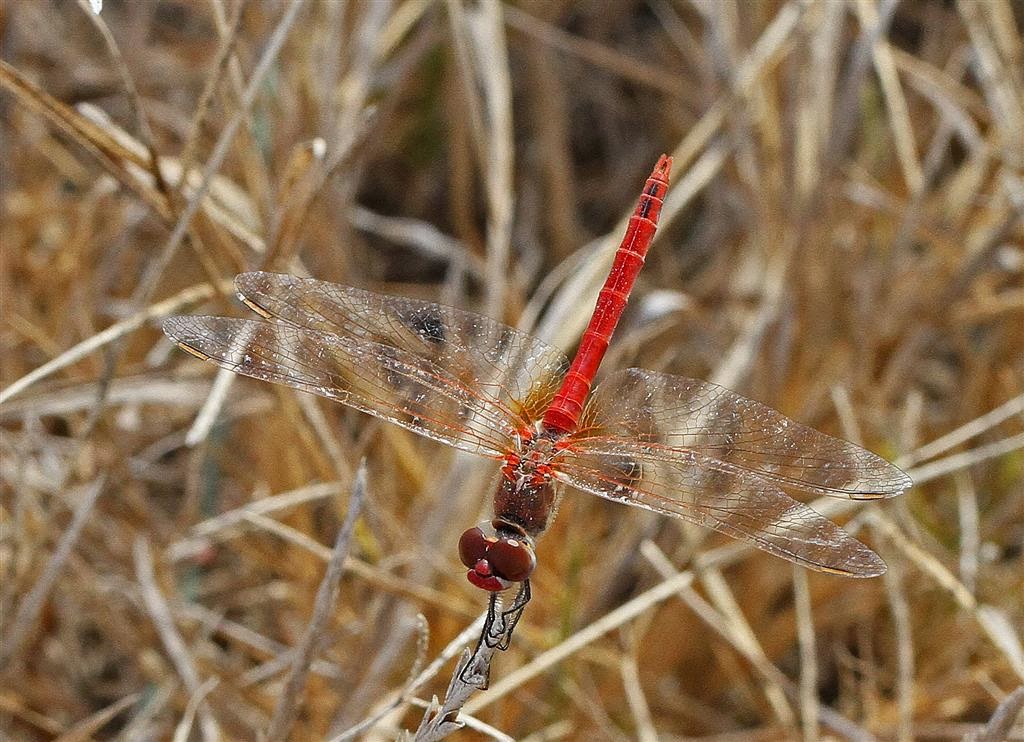
Red-veined Darter (Sympetrum fonscolombii) was represented by two males (one far from water near Polis - upper photo - the other by the second bridge upstream from Polis)


Three male Scarlet Darters (Crocothemis erythraea) perched near a damp trickle provided for the cattle at Fassouri reed beds.


......... a lone male Lesser Emperor (Anax parthenope) patrolled the margin of the Evretou reservoir.........


.....and a male Migrant Hawker (Aeshna mixta) perched in dense vegetation by the second bridge at Polis.


Other than these, there was very little Odonata apart from three Blue-tailed Damselflies (Ischnura elegans) of which one was an ovipositing pair - again at the second bridge above Polis.

Friday, 20 September 2013

The Oak Bush-cricket (Meconema thalassinum) near Preston


August 22, 2013:
In north-west England, the Oak Bush-cricket has been recorded from very few localities although southwards of the Bristol Channel to The Wash, it is distinctly common. Without a doubt it is only thinly scattered here in the north but its nocturnal life-style, its inability to stridulate and therefore not to be picked up on an electronic detector, and its elusive habit of spending the day-time hidden on the underside of oak and other leaves, all contribute to its apparent scarcity.


After several searches during the summer, I was pleased to finally locate a mature male near to Red Scar Woods on the north bank of the Ribble by shaking the lower branches of a mature oak over a net.

 
The first official record for the Ribble woods was in August 1981 followed by sightings at two other spots in August 1985. Since then, none have apparently been submitted to the official authorities although rumours of later sightings exist. The place where I found it was at least a half-mile from the nearest known record and it’s very likely that it’s quite widespread in this large area of woodland.


After being examined it was released back onto the same oak tree from where I found it. 


Friday, 6 September 2013

Adonis Blues (Lysandra bellargus) near Stroud. Gloucestershire

September 3. 2013:
On a small piece of sloping limestone grassland, several second (autumn) brood Adonis Blues were flying in warm sunny weather. Mostly, they nectared on the flowers of scabious and marjoram but also sometimes rested on dead grasses. The distinctive intense sky-blue colour of the males could easily be picked out even at a distance.

 
This is probably the most northerly colony in Britain and surprisingly is a site where the grass is quite long, much different to the short-turfed habitat that the butterfly normally favours.


All males above


Females


Friday, 30 August 2013

Brown Hairstreaks near Oxford

August 28, 2013:
The Brown Hairstreak (Thecla betulae) is only found in a quite restricted region of Britain, mainly in Oxfordshire and neighbouring counties. Like its close relative, the Black Hairstreak, it only occurs in close proximity to its larval food-plant, the Sloe.


Brown Hairstreaks are very elusive butterflies and spend most of the time high up in the trees but when the weather conditions are favourable they can come down to nectar on flowers whilst the females also descend to lay their eggs on the sloe.


Larval food-plant: the Sloe


They mainly occur in quite small, scattered populations so sightings rarely consist of  more than just a few individuals.


The morning was spent at Otmoor under ideal conditions but no sightings were made (although a female had been seen and photographed here earlier in the day). A second well-known locality, Whitecross Green Wood, was visited next but again none were seen. Other people also searching had no luck either (although there were two probables very high up in a master Ash tree). So, a return was made to Otmoor for one last attempt and this was rewarded with a male perched on bramble in dense vegetation. After making such a long trip it was pleasing to have success at last although it had taken four hours of almost constant searching.

 
A Red Kite circling over the site at Otmoor